I set off on my adventure on a sunny day in June. I am accompanied by a family member, as I figured that two sets of eyes are better than one!
We travel westward. The map below shows our route. Our destination is the Vancouver neighbourhood of Shaughnessy.
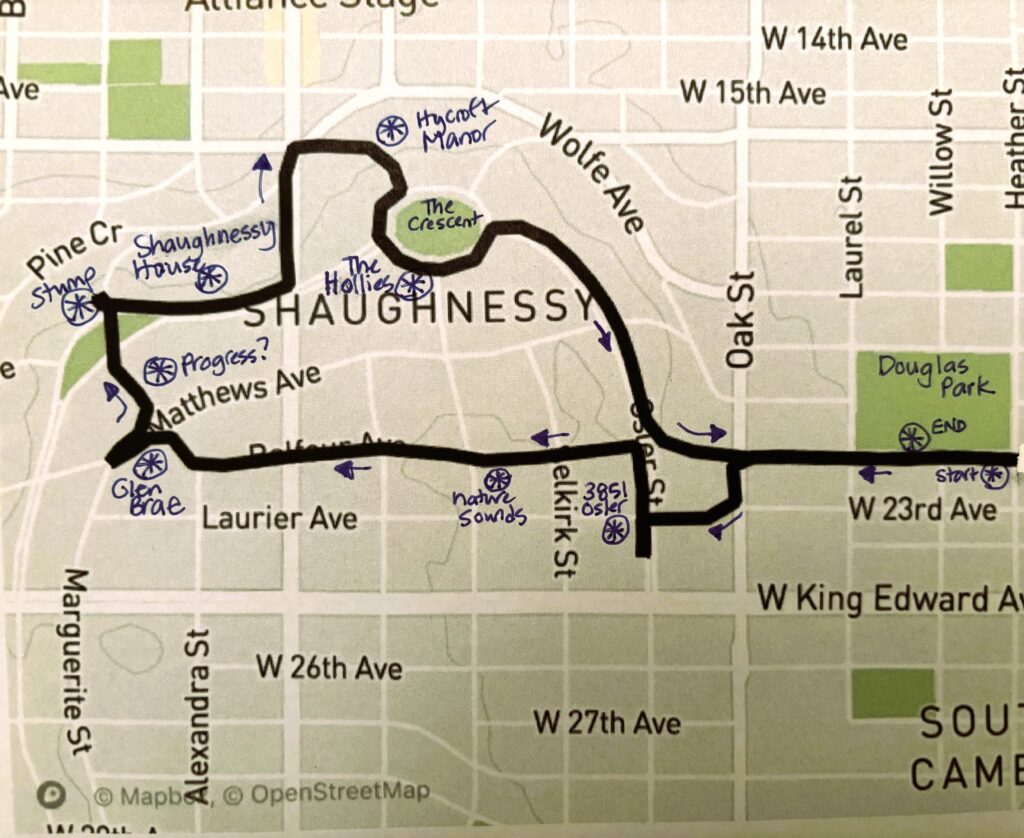
The above illustrates what makes Shaughnessy so unique in the city. Vancouver was laid out largely on a grid. In contrast, this area built by the Canadian Pacific Railway (CPR) and named for its First President Sir Thomas Shaughnessy, is not regular. It is a wonderful meander of larger lots and curved streets with stately mansions. Its core was designed prior to the automobile, so it offers large sweeping driveways up to covered porch areas (porte-cocheres) where residents could park their carriages under cover.
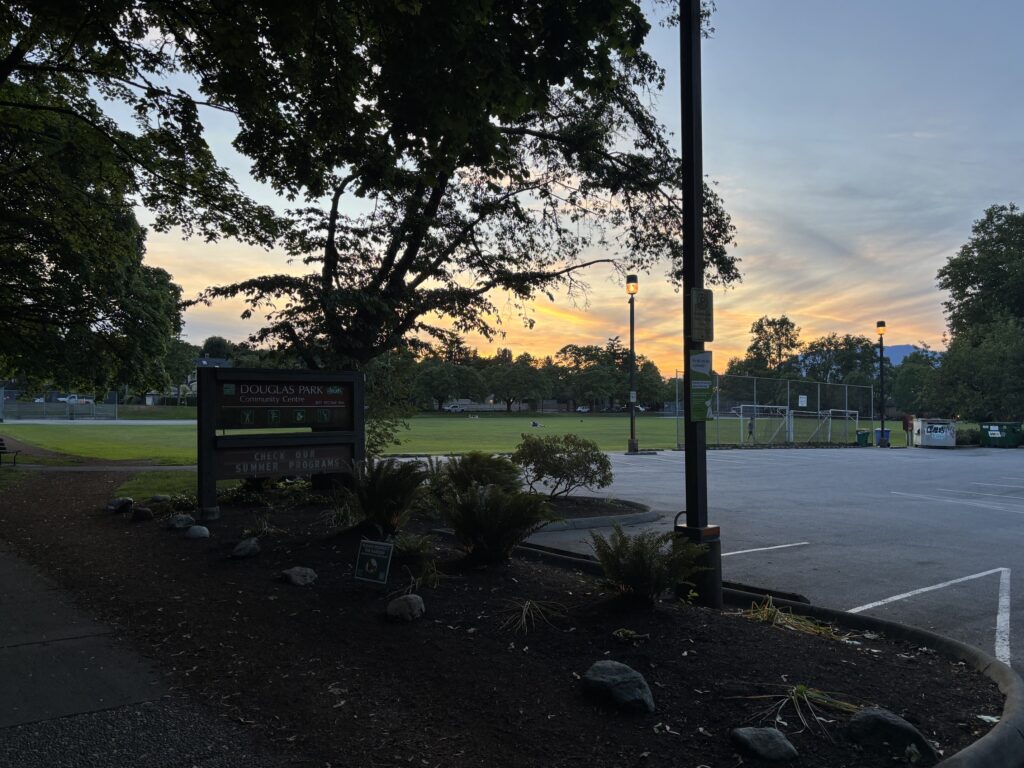
Our adventure begins in a typical tree lined area of Vancouver, with the mountains in the distance. Douglas Park is a large active park where softball, cricket, and soccer are played. It also offers an amazing view of the mountains along with a spring sound so often found near parks.
Our path then leads across Oak Street into Shaughnessy.
At our first stop, 3851 Osler, things take a darker turn.
Onward!
The link below conveys the wonderful nature sounds that can be found right in heart of the City in this wonderful area.
Glen Brae Manor – 1690 Mathews Avenue
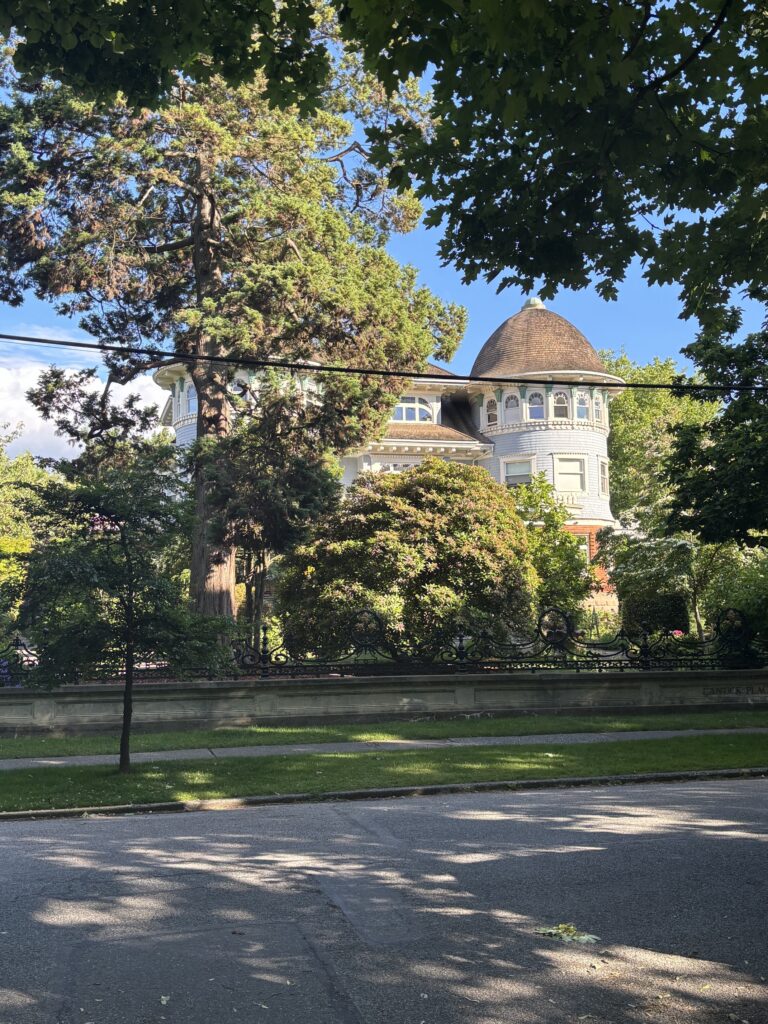
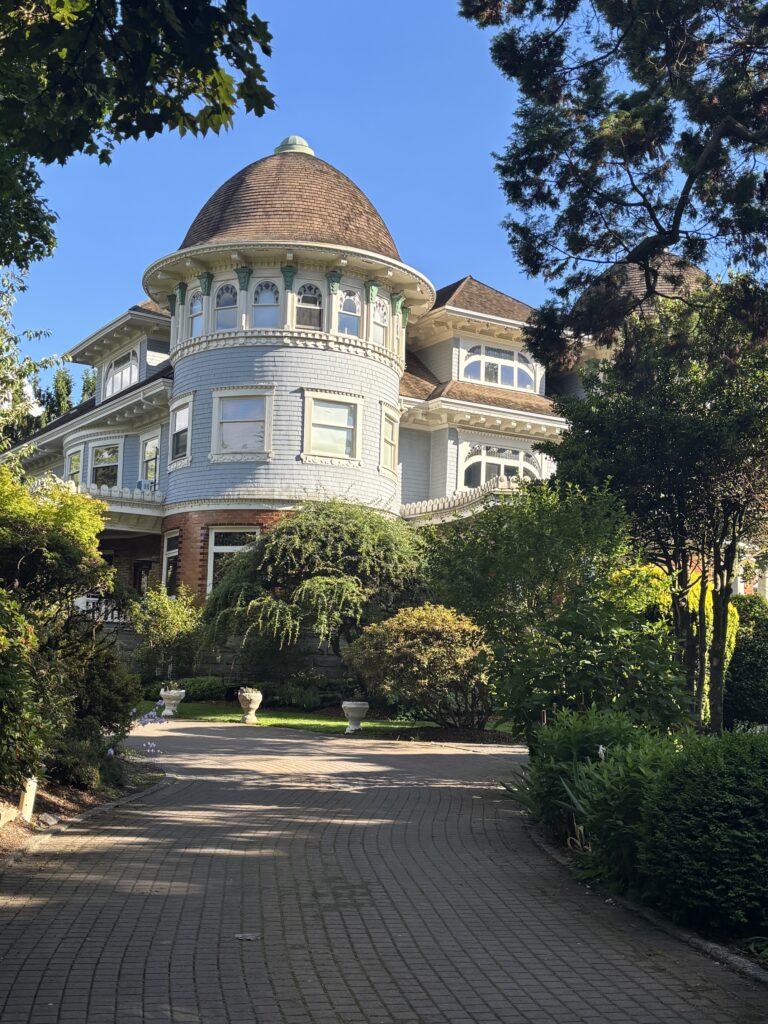
As we cross busy Granville Street we come to Glen Brae Manor – 1690 Mathews Avenue. It is a stunning double domed house bult in 1910. I love the architecture and the incredible detailing, such as the coloured stained glass visible in the upper windows.
The house is now Canuck Place Children’s Hospice, offering children’s palliative care.
Northbound on Marpole Avenue
As we head north, it is inevitable that we will stumble upon “progress” (construction sounds) even in this incredible old world sanctuary. 20th century reminder from the phone that I was on low battery!
The preservation or restoration of many of these old houses is very costly. Many of these houses are able to be retained through incentives which allow the addition of townhouses and coach houses on the property.
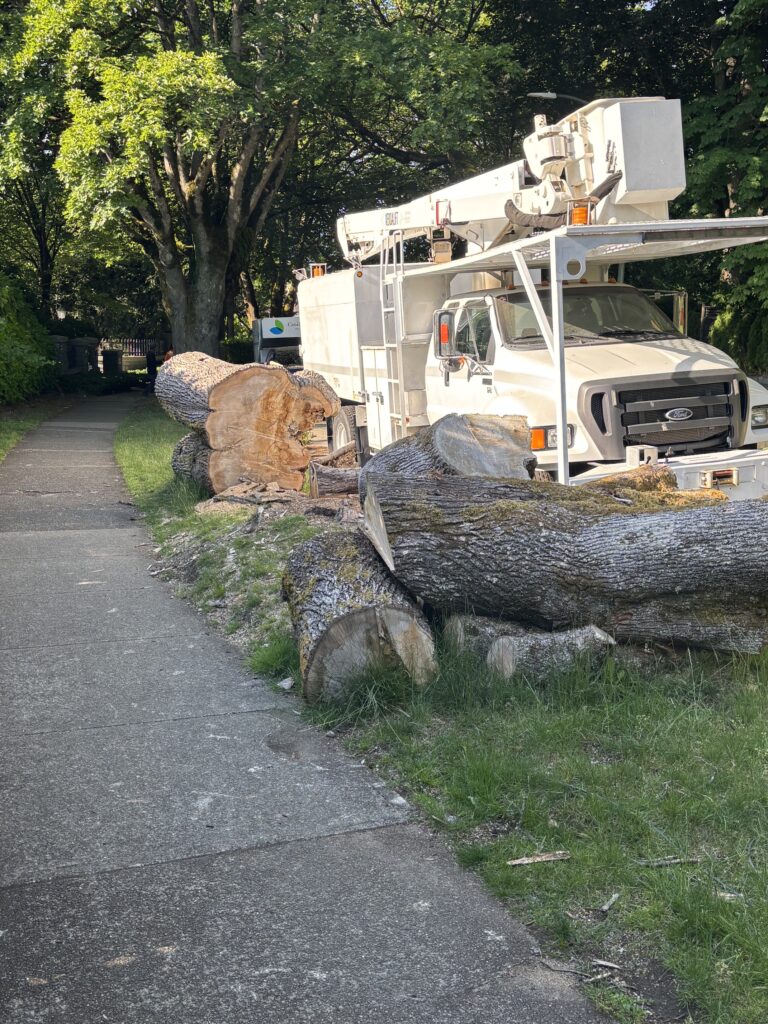
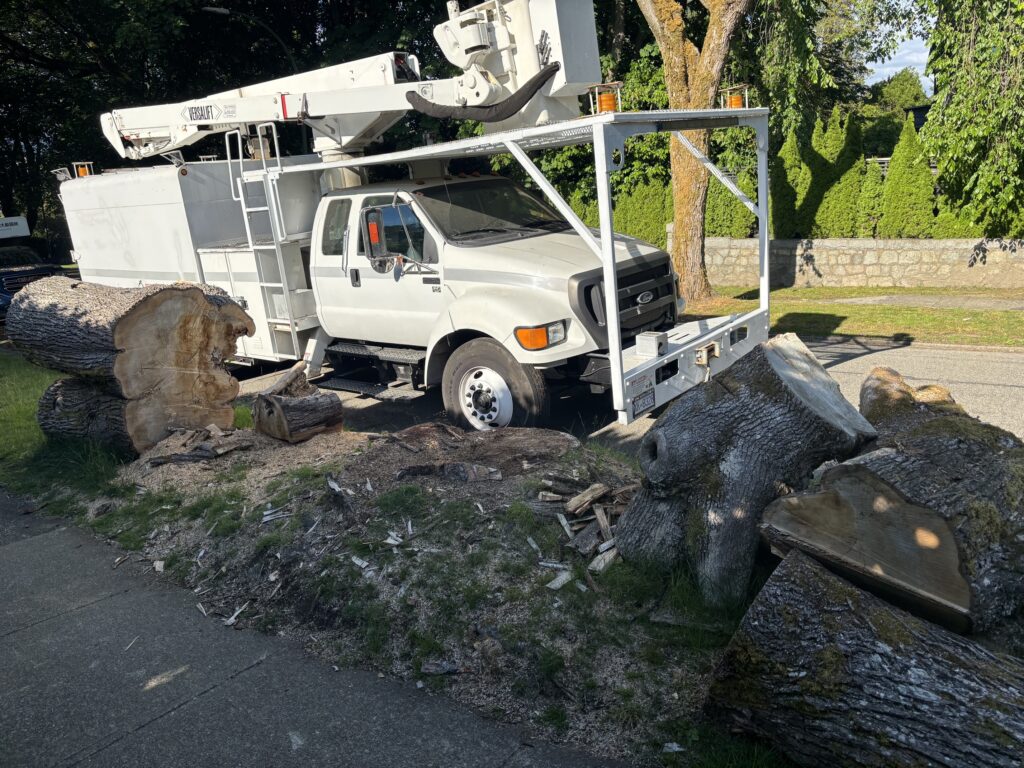
We also happened upon the removal of a diseased or distressed street tree. The scale of the massive pieces and the stump left me in awe.
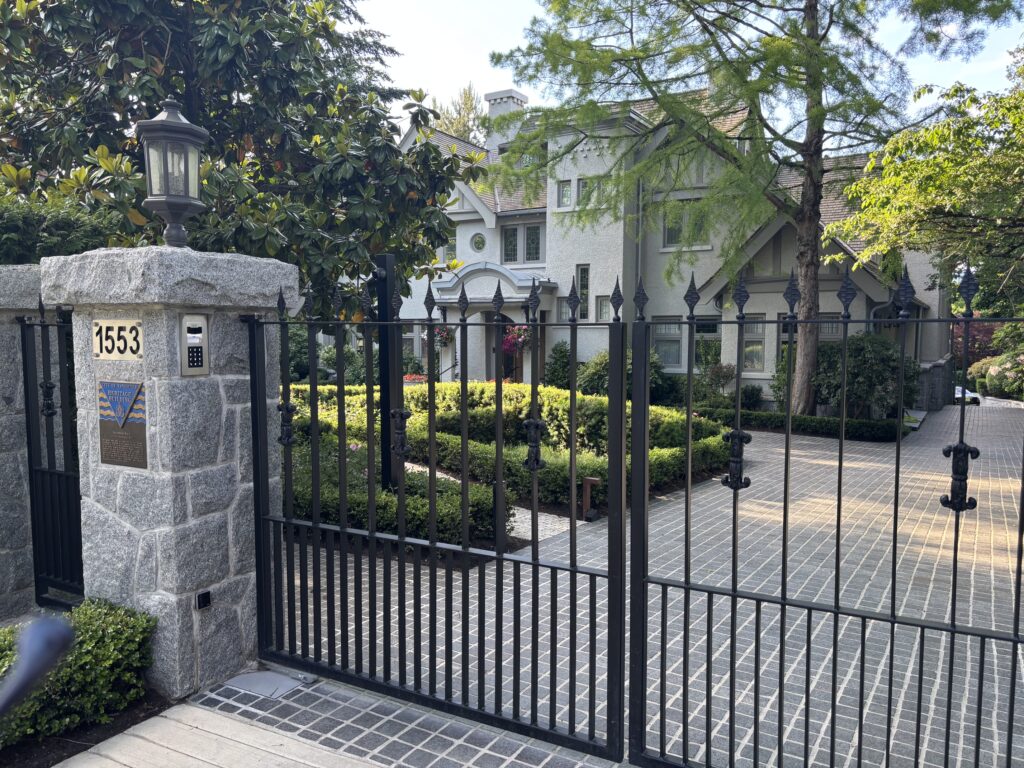
As we walk eastward, we come upon Shaughnessy House on Angus Drive. The house is an example of an Arts and Craft house in Vancouver. It was built for Sir Thomas Shaughnessy, the then president of the CPR. This stately manor was preserved by allowing other units to be built on the property.
East to Hycroft Manor – 1483 McRae Avenue
It is here that we pick up the story of the poor Janet Smith.
Hycroft Manor, above is another mansion in the area. It is now the University Women’s Club.
The Hollies – 1388 The Crescent
Vancouver’s most exclusive addresses are arguable on The Crescent (which is the name of the street). Huge mansions with spacious grounds front onto an oval shaped park in the centre. I have been to the greenspace when there was a violinist playing, sadly that musician was not present on my adventure day!
The Hollies, built in 1914, is a departure from the traditional house design found in the area. The house looks more like a Greek Acropolis or a Roman structure than it does British. Even 100 years later, the place just looks magical to me.
As we head eastward, we return to the typical street grid pattern, with smaller sized lots.
We return back to Douglas Park, with a glorious sunset to end the adventure. Another magical day in Vancouver. I hope you enjoyed our adventure into the past.
Sources:
Forbidden Vancouver, Haunted Vancouver the Death of Janet Smith, 2017, The Daily Hive. https://dailyhive.com/vancouver/haunted-vancouver-the-death-of-janet-smith
“The Hollies.” Vancouver Heritage Foundation, Vancouver Heritage Site Finder, www.heritagesitefinder.ca/location/1388-the-crescent-vancouver-bc. Accessed 09 June 2026.
“Shaughnessy House.” Vancouver Heritage Foundation, Vancouver Heritage Site Finder, Vancouver Heritage Foundation, https://www.heritagesitefinder.ca/location/1551-angus-dr-vancouver-bc. Accessed 06 June 2026.
———————-
Process and Reflection for this adventure
I walk around this area regularly so it was natural for me to consider it for my adventure. The challenge was how to make it interesting and incorporate Mayer’s Principles of Multimedia learning. I was speaking to my family about the task and they mentioned the Janet Smith murder, as these homes were once included on a Halloween spooky tour. Exactly what I needed for the adventure, a “hook.”
The Draft process really assisted me in creating this work. My classmates suggested a more detailed map to assist with signaling. It was also suggested that I ensure I set the stage about the neighbourhood to convey why it is different and special, which was also great feedback.
I really learned a lot in the class around the creation of multimedia and the tools that were available. Without this knowledge, it would have been very difficult to complete this task.
I went on my adventure about two weeks prior to the assignment due date. This allowed me lots of time to think about what I wanted to say, how I wanted to convey it and how to visually present it.
One unexpected challenge I faced was that I was unable to get close to the houses I sought to display (such as the Hollies), due to the large fences and gates. Once I realized I could make slide shows, I sought out historic photos that showed the detailing and architecture of these houses to incorporate those images into my story.
Mayer’s Principles of Multimedia Learning
Signalling Principle
I began my story with a visual map along with general information about the area to signal to the reader as to the path of the story. I also used headings both for segmenting and also for signalling. This prepares them for what is to come and adds in the learning.
Coherence Principle
In accordance with the Coherence Principle, I focused on incorporating a variety of interesting photos, videos and audio to add to the experience. Once I learned about Janet Smith, I felt narrating part of her story was a good fit with my adventure. I did the narration and then overlaid the audio onto the photos I took of those houses. I was careful to be not too text heavy, as I wanted the story to flow.
Modality Principle
My presentation uses multi-media, in accordance with the Modality Principle. For example, I was never able to film the actual truck with its sound. So when I heard the truck, even though it was half a block away, I quickly made an audio recording. I made the best of it by combining that sound with images.
I also used this for the voice overs relating to the tragedy of Janet Smith. I believe the voice overs relating to the unsolved cold case adds interest and intrigue to my adventure. These were aimed at reinforcing and complimenting various forms of learning.
Redundancy Principle
I edited my adventure using the lens of Redundancy Principle. I initially had some other houses I could have mentioned, but instead pared these down to ensure my story flowed. I also sought different architectural styles for the houses to add interest. I reviewed the draft after a good sleep to make improvements to its flow.
Continuity
I strived to follow the Continuity Principle. I have placed captions directly below images to ensure effectiveness. I placed the stump photos in a side-by- side grouping so that viewers could easily view them together.
Mayer’s Cognitive Theory of Multimedia Learning related to Social Cues
With reference to the Social Cues section, I worked to use the Personalization Principle and make the story very accessible, through conversational language.
I had originally thought about using a spooky AI voice for the narration parts. Once I read and learned about the Voice Principle I chose to do the narration myself. This is because human voices are more easily digested by listeners and more learning occurs. My narration adds to the adventure, as I strived to use a differing intonations which made it more interesting.
Finally, thank you very much for coming along on my adventure. I really enjoyed creating the story. I hope you enjoyed it as well!
Leave a Reply